Categories
Topical

The contradictions are sharpening – Zohran Mamdani and the Left Alliance Youth’s Socialist working-group

This is a handtranslated version of the original statement that was released in finnish. You can read the original finnish version from this link ==>


Editor’s note for international readers:

To understand this article, it is important to understand the difference between the Communist Party of Finland (CPF) and The Left Alliance (Vasemmisto). This article does not talk about The Communist Youth’s mother party, which is the CPF.

CPF is a revolutionary communist organisation, based on the scientific theory of socialism developed by Marx, Engels and Lenin. CPF does not have any elected officials in the parliament, Left Alliance on the other hand has 11 out of 200 seats in Parliament.

Politics-wise The Left Alliance (Finland) is a democratic-socialist party, which has a decades long history of anti-communism and refusal to co-opeate with communist forces in Finland and internationally. The latest culmination of which happened in the recent split of the The Left Alliance (Finland) from the more-communist-aligned European Left (in which CPF is a member) to a newly formed splinter organisation European Left Alliance.

The Left Alliance (Finland) has a decades long history of expelling communist members from the party.

The Communist Youth of Finland thus views The Left Alliance as a historically counter-revolutionary and an anti-communist party. This is why we do consider the developments depicted in this article as important, as they show a growing marxist force in The Left Alliance Youth.

Viivi Rantajääskö
Chairperson of the Communist Youth of Finland
14th of November, 2025


On 4th and 5th of November there has been discussion in the Finnish media about two large recent advances for our movement. First of all, Zohran Mamdani, a democratic-socialist from New York, was elected (as expected) as the new Mayor of New York City with over 9 %-point differnce to the independent candidate Andrew Cuomo (Mamdani: 50,4 % of the vote, Cuomo: 41.6 % of the vote; source: APNEWS)

Zohran Mamdani is a very fresh breath of air of radicalism to the stale politics of USA. He has in 2020 for example openly stated how USA needs means of production owned by the workers.

During his campaign, Mamdani has fallen back on a less radical line. He has ran on a platform of making New York more affordable to its citizens, but making public transport and daycare free, adding rent controls and creating grocery stores owned by the city. (Aljazeera)

But unlike Trump and other political enemies of Mamdani have declared, these demands do not make Mamdani a communist. Mamdami, for example, has not demanded during his campaign that private ownership in the economy should be abolished – unlike communists who demand a radical change to our entire system of profuction to a system where the government lead by and for the working class manages entirely the means of production and the planned economy. As a democratic-sociaist Mamdani thus represents the maintenance of the current system, only asking for a “more humane form of capitalism”. (Aljazeera)

On the viewpoint of reform, we the Communist Youth of Finland see that Mamdani’s historical victory is a big step forward for the quality of life for the citizens of NYC and we thus celebrate this victory in solidarity. We are really happy to see politics, that break down many of the taboos of the political landscape of the USA.

In the Finnish context, breaking taboos around politics has also been active in the recent days as the Left Alliance Youth’s Socialist Working-group released its pamflet on socialism to the congress of the Left Alliance Youth. Of course the finnish sensational news network Iltalehti took an advantage of the situation and released an article depicting the Left Alliance Youth “inner growing threat of communist forces”. Even though the pamflet itself was only an educatory narrative of the basic principles of socialism, the finnish big-capital clearly sees even this kind of work of a miniscule group of people as a grave threat to their existance. We, the Communist Youth of Finland are delighted to see thath the Left Alliance Youth is facilitating an ever greater dialogue of socialism and marxist theory in their organisation. For us to build a new threat to the current system, we need to know our history and marxism as the revolutionary tool of the working class.

We do still want to keep in mind that alongside these positive developments we need to remember what has happened every time communist – and radical left perspectives – have become more accepted in soviety. The growing success of leftist lines in elections and in society in general has always produced strong counter-reactions, of the beginning of which we might be witnessing in the attacks directed at Mamdani and Iltalehti’s scandal-out-of-nothing directed at the Left Alliance Youth.

When our democratic system stops serving the interests of the bourgeoisie in power, there has always surfaced a counter-reaction to democratic systems in themselfes. For example in Germany after the first world war the success of the socialdemocrats brought to power fascist militias, whom were supported by big internation capital. In Finland, when the communists enjoyed parliamentary power through SKDL amidst 50s to 70s, there grew a strong counter-reaction in forms of Suomen Yhteiskunnan Tuki -foundation, among others. SYT was completely funded by finnish big capital, bourgeoisie parties and even some backwards labour unions (an excellent narrative of SYT is told in Vesikansa’s book called “Salainen sisällissota”). SYT was one of the most dominant crusaders of anti-communism in Finland. They did wide variety of work publishing anticommunist propaganda, they co-operated with the finnish secret police and they even took party in inner sabotage of the Communist Party by circulating falsified statements from made “opposition groups” in the party. This co-opeation between SYT and the secret police went even so far as stopping leftist teacher-students to enlist in studies for teaching in universities. (HS)

Internationally again and again a great example of international revolutionary counter-reactions stands out the murder and overthrow of the democratically elected socialist president of chile, Salvador Allende. Allende took office on 3rd of novemeber of 1970 and just three years later was overthrown by the fascist dictatorship of the Pinochette regime, backed by the USA.

We, the Communist Youth of Finland are delighted by the developments in our movement of the past year. The power and importance of socialism, communism and marxism in our sociatal discussions is growing. This is a huge change to our movement, this moment in time needs to be remembered as a historical beginning of the new revival of the radical working class movement after the decades of withering away, anticommunism and overall backwardisation of organisations.

Now, exactly now, is the time the most fruitful for every worker to organise themselfes as party of revolutionary fighting organisations, like the Communist Youth of Finland, who are fighting actively for a better, more democratic economic base and alternative to the current system of oppression and exploitation. Now is the beginning of newfound revival, now is the short glimpse of hope before the counter-reactionary forces start realising that our movement is rebuilding. Now, more thatn ever, it is time to organise.

The Communist Youth of Finland, 6th of November 2025

Categories
Topical

Solidarity and exposing the EU’s shameful actions on Western Sahara’s Independence Day

The Sahrawi Arab Democratic Republic, Western Sahara, declared itself independent 48 years ago, on February 27, 1976. However, occupation, colonialism and exploitation of natural resources continue by Morocco. Communist Youth of Finland sends greetings to the Sahrawi people on Independence Day and demands a commitment from the international community to put pressure on Morocco for the implementation of independence of Western Sahara. 

The occupation has always been illegal and there are no cultural or historical ties to justify it.

Western Sahara is the last colony in Africa that is still on the UN map of colonies. The dispute over the Western Sahara region intensified in December 1975, when the colonial power Spain withdrew from the region. Before this, Spain had agreed with Morocco and Mauritania that the two countries would temporarily divide the Western Sahara region. The Sahrawis, of course, strongly opposed the continuation of colonialism. Polisario and Mauritania made peace in 1979, after which Mauritanian troops withdrew, but Morocco began to occupy Western Sahara on a larger scale. 

The occupation has always been illegal and there are no cultural or historical ties to justify it. This was confirmed by the decision of the Hague Criminal Court in 1976. Moroccans and Sahrawis are different peoples. The occupation of Morocco is due to Morocco’s desire for expansion and natural resources. The claim of common links between the regions behind the occupation has been refuted from the beginning. Does Morocco occupy all North African countries only because all countries are related to each other in terms of Arab origin, religion and language? 

The EU supports the continuation of colonialism 

On the basis of the trade agreements between the European Union and Morocco, vessels from the EU countries have been able to fish in the territorial waters of the Western Sahara, and for example, tomatoes whose country of origin is marked Morocco are sold in Finland, even though the tomatoes are produced in the Western Sahara. 

According to international law, the natural resources of the occupied territory can only be used after the approval of the local population. The Sahrawis’ position has not been asked, so the trade agreements between the EU and Morocco grossly violate international law. Most recently, in 2021, the EU court found three agricultural and fisheries agreements between the Union and Morocco to be illegal, as the territorial waters of the Western Sahara cannot be considered to belong to Morocco. However, the EU has not seemed to commit to the decisions of its own court. 

Especially during the European elections this spring, it is necessary to highlight how the EU has not recognized the Polisario as a body representing the Sahrawi people, and to present demands for recognition and negotiation and cooperation with the Polisario. 

It must be made clear to Morocco that the violation of international law and the continuation of colonialism cannot be accepted.

The UN has agreed to be held an independence referendum in Western Sahara as early as 1992, but since Morocco knows that the Sahrawis stand on the side of achieving independence, it does not want the referendum to take place and is doing everything to prevent the plans. However, it must be made clear to Morocco that the violation of international law and the continuation of colonialism cannot be accepted. 

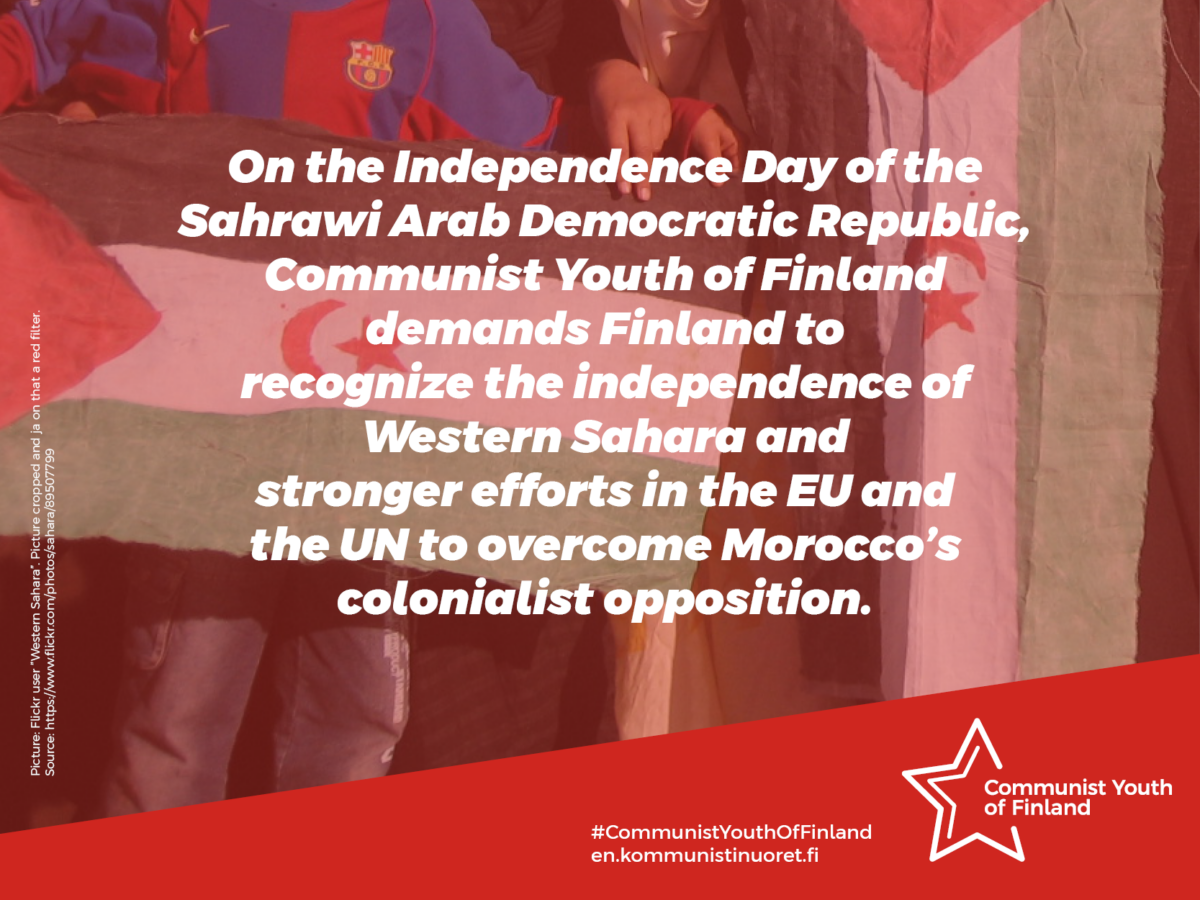
On the Independence Day of the Sahrawi Arab Democratic Republic, Communist Youth of Finland demands Finland to recognize the independence of Western Sahara and stronger efforts in the EU and the UN to overcome Morocco’s colonialist and groundless opposition and to implement the Western Sahara independence referendum, peace and justice.

Categories
Topical

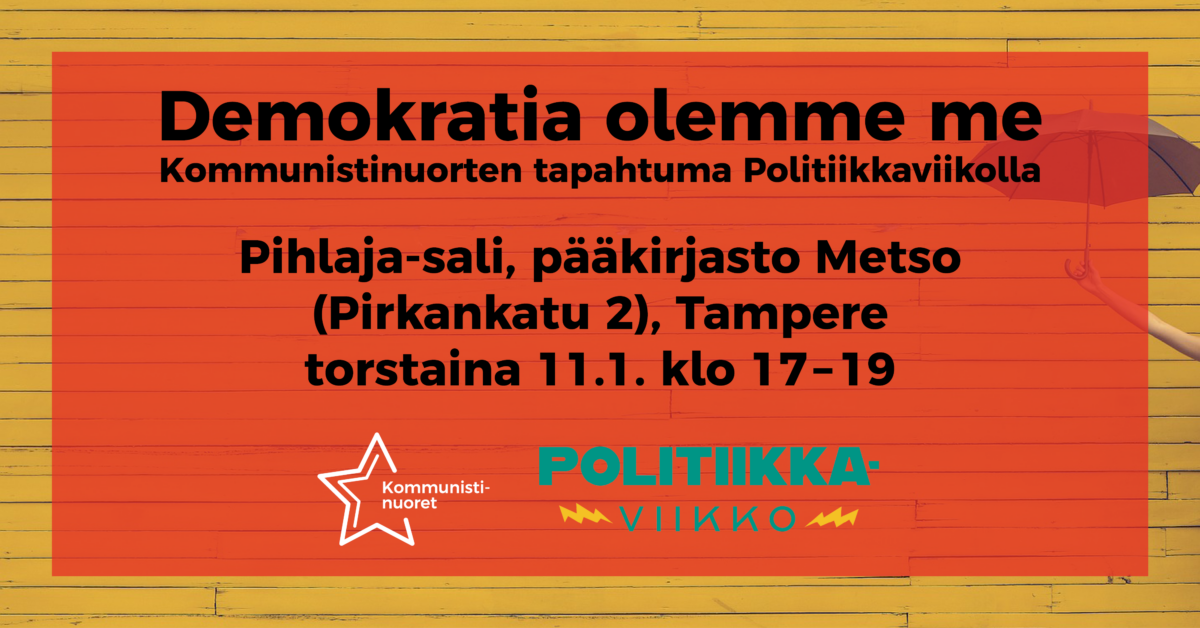
Our event on Politics Week “Democracy is us” in Tampere on 11th January

Communist Youth of Finland is organising a public event on Allianssi Politics Week about democracy for everyone interested. We’re discussing community, grassroots organising and low threshold advocacy. Topics also include capitalism’s systematic obstacles to the power of the people and the undemocratic nature of the EU’s structures.

Welcome to the main library of Tampere, Metso in Pihlaja hall on Thursday January 11th from 5pm to 7pm! The street address is Pirkankatu 2, Tampere. Metso has an accessible entrance, WC and parking.

Politics Week is held together with the Youth Election on January 6.-12. Communist Youth of Finland is an official partner of Politics Week.

Facebook event page

Categories
Topical

Communist Youth of Finland has joined Bluesky

One new channel was added to the scale of our social media channels today. Follow Communist Youth of Finland on Bluesky! Most of our content will be in Finnish but we publish sometimes also in Swedish and English.

Categories
Topical

In Defense of Labels

Written by a nickname

Shorter version of this text has been translated and published in Finnish on Tiedonantaja newspaper’s edition 10/2023

Coming out as transgender was a true crash course in the different ways that people react to surprising news. Some were left completely speechless, some reacted with anger or rejection, and others were confused and told me my announcement had come out of nowhere. Some responded with excitement and positivity, others with lengthy accounts of various positive relations they’d had with queer people, and others still with a simple hug.

One of the most common responses to my coming out, however, was one that I’d never anticipated. It involved a relatively consistent line of questioning along the lines of “why do you need to call yourself a woman? Why not just be yourself? Why not just be a person”.” Such a response tended to initiate a lengthy discussion during which I sought to reassure the questioner that I wasn’t caught up on some stereotypical understanding of what ‘men’ and ‘women’ can be and that I wasn’t going to restrict myself to a narrow identity box, whilst at the same time attempting justify why I still desired to use the term ‘woman’.

I always found such conversations unpleasant, dissatisfying, and invasive. The questioners always appeared caring and concerned for my wellbeing, but I was upset by the assumptions they seemed to be making about me: that I was some sort of gender essentialist with a static or reactionary view of what different sorts of people can be. At that time, I was hallway through a PhD applying post-structural, queer and feminist theory to environmental politics, and I couldn’t help but be offended. I wanted to say “do you honestly think I haven’t considered these sorts of matters before? Thinking about them is literally my job!” Even so, such conversations always managed to unsettle me in a way that even the very negative reactions to my transness never did. My sense of self was very fragile at the time, and I remember spending long hours contemplating whether my questioners were right, if only because of how frequently such conversations kept coming up. Why did I need to be a woman? Why couldn’t I just be myself?

In retrospect, however, I don’t think that my initial understanding of what was happening during such dialogues was accurate. For one thing, I no longer believe that a wide variety of friends, colleagues and acquaintances were moved to question transness due to deep-felt concerns that my understanding of the world was insufficiently post-structural. If that had been the case, then surely my well-rehearsed speeches emphasizing the sophistication of my analytical frameworks would have been sufficient to reassure them, and – to my frustration – they never were.

Instead, I now believe that the true aim of this reaction was far simpler – to deny what I was saying and to try and make it go away. I was asking for them to accept me as a woman and, furthermore, to come to terms with the future changes to my body and life that my transition would entail. They didn’t want to do that, and some part of them must have hoped that, by challenging me, they might not have to. The question “Why can’t you just be yourself” really meant “why can’t you just not change”, and by extension, “why can’t the way I relate to you stay the same?”

My current understanding of the meaning of such conversations has developed as a result of going through and witnessing a number of additional ‘coming out’ moments in subsequent years, each of which was met with essentially the same sorts of reactions. For example, both times that I opened up to friends and family after receiving a neurodivergent diagnosis, I was subjected to repeated, detailed interrogations regarding whether I was going to use my new label to limit or caricature myself. When my spouse came out as non-binary, they received

very similar reactions, which is particularly ‘funny’ given that ‘non-binary’ is surely the textbook example of an anti-essentialist label. Apparently not, because the same question was posed. “Why do you need to take on this ‘non-binary’ label? Why can’t you just be you?”

When did everyone become so afraid of labels? Or, to put my concern more bluntly, how have anti-label and anti-essentialist arguments become such a go-to option for those actually seeking to preserve the status quo?

Anti-essentialism, as an intellectual and political idea, has been a major current in the leftist cultural and political sphere for over a century, and particularly since the counter-cultural movements of the 1960s. In broad strokes, it covers perspectives that challenge fixed or binary categories through which we understand the world, social systems and human nature by highlighting the contingent and political histories and power dynamics involved in producing the realities we often take for granted. Such perspectives, having long been championed in various forms by the many of the rockstars of the leftist intellectual tradition including Sartre, Foucault, Deleuze, Butler and Derrida, have become received wisdom within many progressive circles. Indeed, amongst many, essentialism has emerged as the greatest political enemy of all – even surpassing Capitalism – and the work of escaping all fixed identities has emerged as both the pivotal personal/political project and as the surest pathway to a better future.

I do not intend here to integrate the wisdom or validity of such approaches to the theory and practice of social change. Instead, I want to explore how, in the context of an anti-essentialist, label-skeptical cultural milieu, arguments derived from can be used effectively, and with a great deal of apparent legitimacy, for very essentialist, and very reactionary ends – in other words, how they are capable of working in the opposite way to how they were originally intended.

In my experience, being denied the possibility of putting one’s identity into words often feels nothing like freedom – it can feel like having one’s identity and one’s needs banished into an unspeakable void. In a word, namelessness can feel like a prison. Conversely, the moment that a name is given to something is often the precise moment that it becomes ‘real’, ‘tangible’, and actionable. For years I hadn’t given a name to my feelings of gender dysphoria. I didn’t feel them any less, but I couldn’t fully understand or grasp them. I felt deeply, inescapably lost. The moment I finally accepted that I was trans – the moment I said it out loud – was the moment that my life changed – that I was once again able to start living. As a further example, it is impossible to doubt the profound social impacts resulting from the efforts of Marxist theorists to assign existent social dynamics a clear and precise vocabulary. The terms ‘bourgeoisie’ and ‘proletariat’ may not have created these social identities, but it gave those struggling under capitalism a vocabulary to understand their plight. Labels, in this context, have served as a tool in pursuit of social freedom.

Furthermore, irrespective of whether we are personally comfortable with labels, they are applied to us anyway, by social systems which normatively ‘read’ us, assigning us our identities and, to a substantial degree, our fates, without any regard to our active consent. From birth, we are never looked upon as blank slates. When I tell someone “I am queer”, or “I have diagnosed neurodivergence”, I am upending others’ ability to implicitly maintain me within the sphere of their idea of ‘normal’. I am making a clear demand to be seen and engaged on certain terms, and if this ignites resistance, it is often precisely because there is a desire on the part of many to block that from happening. In such contexts, phrases like “why can’t you just be yourself” doesn’t mean “be something truly beyond words, emancipated and free – it means why can’t you just accept the vocabularies that have already applied to you?

In other words, in spite of whatever they might say, I believe many of those who react with knee-jerk anti-label arguments to the efforts of individuals to put their identities into words do so precisely because they acknowledge the power associated with doing so. On a slightly petty note, it has been particularly maddening to receive lectures about essentialism from individuals that had clearly never needed to question the meaning of being “just themselves” because all the labels they had been assigned fit them well enough to require no deeper examination. It must be an enjoyable experience for such individuals – the thrill of getting to poke at the identity of a newly out trans person, sweetened by getting to simultaneously pose as a radical member of the gender avant-garde.

None of this is to say that labels always serve a positive function. Often, we truly are given more room to maneuver through efforts to escape the grip of certain restrictive terminology. I would know – discovering I was not doomed to be eternally defined by the label ‘man’ was one of the most positive realizations of my life. In fact, my perspective on labels is ambivalent. They aren’t good or bad – they are just a fact of life. Language, as a primary tool through which we contemplate and express ourselves and the social realities we live in, brings with it certain structural limits, insufficiencies and constraints. In my opinion, we will find greater value in continuing to develop our ability to work with this medium, with all its limitations, rather than trying to find ways to escape it.

Using language means applying terms to things – that’s just how it works – and we can continue to do this with the aim of forwarding the causes we value whilst remaining critical of the drawbacks and risks that such performative acts bring with them. There will always be risks that the words we use will be coopted so that we can no longer find ourselves within them and must look for new ones. Indeed, in a world defined by entrenched structural antagonisms and class struggles, we could hardly expect otherwise – language is just another register in which such conflicts play themselves out.

As a final point, I do hope that progressive debates about the validity and role of labels can move on from an enduring obsession with personal identity. What about politics? Part of why I felt so disconcerted by the reactions when I came out about my neurodivergence was because there was a huge rift between how I was thinking about my diagnosis and how others seemed to believe I was thinking about it. For me it was simple. My workplace told me that without a diagnosis, I couldn’t receive certain support I needed to stay in my job. Because of this experience, I pursued a diagnosis, and as a result, I hope that I will have an easier time receiving the support I need in the future. Having received my diagnosis, I found added benefit in being connected through a common label to other individuals facing similar struggles within our current neoliberal economic structure. I have found a new community, new sources of solidarity, and a collective political project in which to participate – one built through years of effort of other neurodivergent individuals.

It is undeniable that many such labels were first developed and applied to neurodivergent individuals to control and ‘other’ them, but through the monumental efforts of these labels’ ‘subjects’, they have become rallying points for collective struggle – struggle intimately linked with the fullness of global struggle to enduring economic and political injustice. I’m tired of talking about what my labels make me think about myself. I want to talk about how we can change the world. I want to talk about how the very real, daily efforts of our present social and political system to undermine and destroy my life based on various aspects of my embodied existence can be named, resisted and overcome.

Categories
Topical

Report of the meeting with CYM

On 19th September Communist Youth of Finland met with Irish comrade organization Connolly Youth Movement (CYM) for the first time online in order to create connections, share experiences and discuss co-operation in general. 

In the meeting Communist Youth of Finland, represented by General Secretary Jiri Mäntysalo, and CYM, represented by International Secretary Ida Wulff, talked about political situation and atmosphere in both countries, fight for the working class, state of the civil societys, activism in the Trade Unions and internationalism. 

Mäntysalo shed light on the tactic and agenda of Finnish communists in elections in Finland. Next year Communist Youth of Finland’s mother party Communist Party of Finland will participate in the European elections and promote the leftist way out of the European Union’s capitalist structures and frames of austerity policies. Mäntysalo also told about Finnish communists’ work in European Left and ELYN (European Left Youth Network). 

Wulff talked about crises in Ireland that the working class must face, question of Northern Ireland, political awereness and activism of Irish youth and the history and international relations of CYM. Wulff also shared some important advice on international organizational work. 

Both organizations share marxist and leninist visions of understanding the problems in capitalist world and the need of strengthening the class struggle for system change.

Categories
Topical

Our new website is out now!

Welcome to the renewed website of Communist Youth! With the renewal, the appearance of the pages has been updated, and usability and mobile optimization have improved.

However, the development of the pages is continuous, so we gladly accept ideas and suggestions for further development.

Currently, only the latest articles from the articles published on the old website are displayed on the new pages, but we strive to make all previous articles visible on the new pages as well.

As before, the pages have their own language versions in Finnish and Swedish too.

Categories
Topical

Goal to ban communist symbols is unacceptable

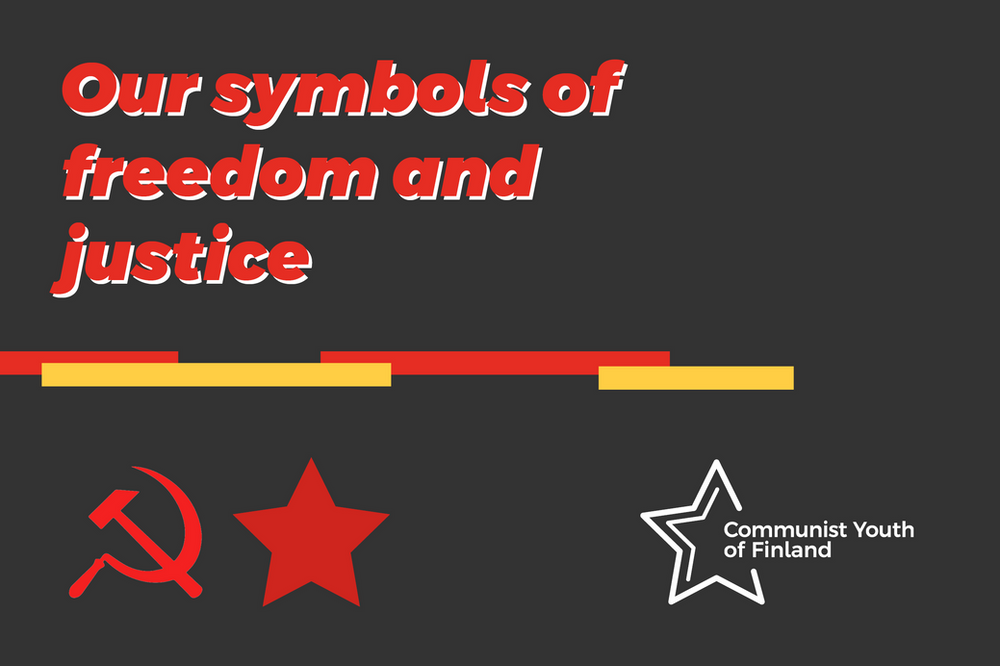
Hammer and circle, our logo and text: 'Our symbols of freedom and justice'.

The latest goal by Petteri Orpo’s and Riikka Purra’s far-right government of investigating the possibility to ban communist symbols in Finland is undemocratic and groundless. It’s unjustified to equate communism with nazism. Communist Youth of Finland will not approve of it.

n

nThe government published a statement to tackle rasism and promote equality in Finland after big debate and scandals around several ministers’ and politicians’ rasict texts and comments. Publishing the statement was government’s ‘quick fix’ to calm the discussion. Orpo’s and Purra’s government does not have credibility to antiracist politics since it has been very difficult for government parties’ politicians to apologise their hateful comments and follow their own guidelines.

n

nIn that statement, it is said that government investigates the possibilities for criminalizing the use of symbols of Nazism and Communism in political context.

n

nNazism as an ideology declares the superiority of one part of the population over others, and justified the killing of millions of those considered inferior. Communism as an idea proclaims the equality of people. The obstacle to equality is the capitalist economic system, and the goal of the communists is to abolish it. Killings and crimes against human rights by leaders of socialist countries were against communist principals and have been denounced by Finnish communists. The communist organizations in Finland are registered, legal organizations.

n

nCommunist Youth of Finland demands a correction to point 18 of the statement regarding the symbols of communism.

Categories
Topical

Polisario and the struggle for freedom of Western Sahara 50 years

Today, 10th May, 50 years have passed since the founding of the Western Sahara’s Liberation Front Polisario. Communist Youth of Finland congratulates Polisario and shows its support to the Sahrawi people of Western Sahara in their struggle for independence, peace and justice, which is supported by international solidarity.

nn

Polisario was founded in 1973 – at a time when Western Sahara was still a Spanish colony. After the end of Spanish rule in the region, Morocco considered it as its own and began to illegally occupy Western Sahara. The Polisario declared the Sahrawi Arab Democratic Republic established and independent on 27th February 1976. So far, 46 UN member states have recognized the independence. Finland is not in this group. In 2012, the Swedish parliament voted in favor of recognizing independence, but the recognition has still not been officially done.

nn

In its decision in 1976, the International Court of Justice in The Hague testified that Morocco’s occupation of Western Sahara is not based on historical ties between the region and the Kingdom of Morocco.

n

We demand Finland to recognize the independence of Western Sahara and stronger efforts from the UN to overcome the colonialist and groundless opposition of Morocco and to implement the independence referendum of Western Sahara.

n

The UN has agreed to hold an independence referendum in Western Sahara as early as 1992, but Morocco is putting the brakes on the plans. We demand Finland to recognize the independence of Western Sahara and stronger efforts from the UN to overcome the colonialist and groundless opposition of Morocco and to implement the independence referendum of Western Sahara.

nn

With the joint efforts of various organizations and civil society, it is possible to bring the situation in Western Sahara into the political mainstream and the human rights debate. It is also interesting to talk about Polisario’s views and to keep clear the demands for the recognition of Western Sahara by Finland and, for example, influence to re-sign the EU trade agreements that discriminate against Sahrawis.

nn

On the basis of the trade agreements between the EU and Morocco, ships from the EU countries have been able to fish in the territorial waters of the Western Sahara, and for example Pirkka tomatoes are sold in Finland, whose country of origin is marked as Morocco, even though the tomatoes are produced in the Western Sahara. According to international law, the natural resources of the occupied territory can only be used after the approval of the local population. The Sahrawis’ position has not been asked, so the trade agreements between the EU and Morocco grossly violate international law. Most recently, in 2021, the EU court found three agricultural and fisheries agreements between the Union and Morocco to be illegal, as the territorial waters of the Western Sahara cannot be considered to belong to Morocco.

nn

Long live Western Sahara sovereignty and Polisario! The Sahrawi people will win!

Categories
Topical

Bex Tapanainen continues as Chairperson of Communist Youth of Finland

Bex Tapanainen.

Communist Youth of Finland elected at its regular Annual Meeting in Turku on March 18 management for the organization and dealt with other annual meeting issues. Bex Tapanainen from Tampere will continue as Chairperson.

nn

Elia Karlsson was elected as the new Vice Chairperson. Jiri Mäntysalo continues as General Secretary and Erno Haverinen as Financial Manager. Emilia Heikkinen, Tiina Heino, Niila Isojärvi, Arvo Lehtomäki and Ada Robbins were also elected to the Board.

nn

In the action plan approved by the Annual Meeting, Communist Youth of Finland is aligned as a deviation from the mainstream dominated by capitalist hegemony, as Finland’s reddest, sharpest and most far-sighted youth organization. Our goal is the workers’ revolution and the transition to socialism and joint ownership of the means of production, which will help us move step by step towards a communist society that will make both states and armies unnecessary. We direct our activities to the target group of people under 35 years of age.